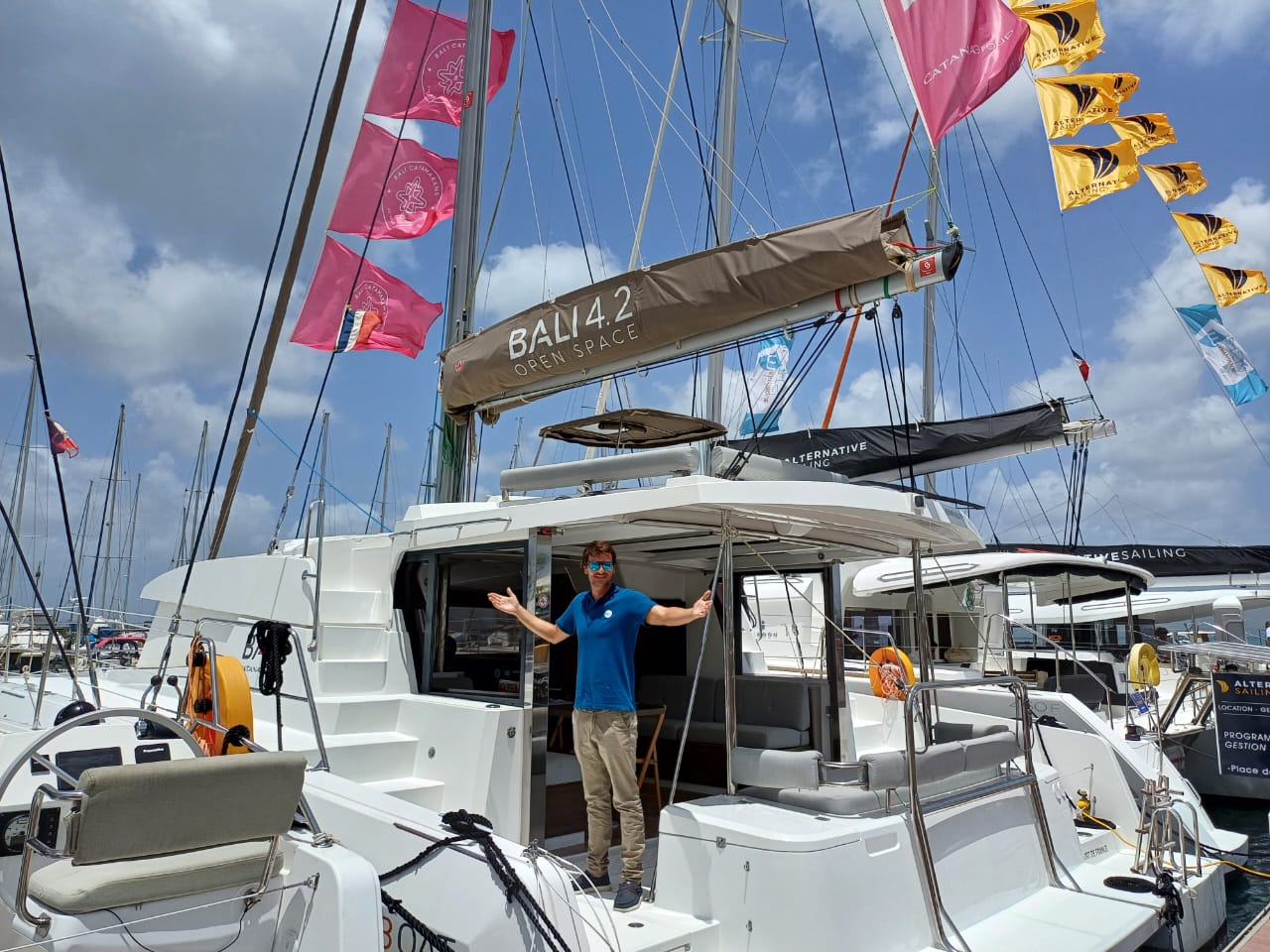
The profitability of the rental management of a catamaran in the West Indies is not limited to a rate announced in a brochure. The difference between the gross income displayed and the net income actually received can be considerable depending on the management program chosen, the expenses incurred, the type of boat and the tax residence of the owner. The passion for sailing can be profitable, provided that you prepare your project perfectly and approach the subject without illusions. This article gives you the real orders of magnitude of the charter sector, the fees to never forget, and the concrete impact of your tax situation, whether you live in France, the United States, Canada or the United Kingdom.
For the management packages offered by RentSailBoat and the conditions of entry into the charter fleet, consult our catamaran rental management page in the West Indies.
Preliminary warning. The figures presented in this article are orders of magnitude based on available market data. They do not constitute a promise of return or tax or legal advice. Individual results vary depending on the model of boat, the length of operation, the management contract and the personal tax situation. It is imperative to consult a specialist advisor for your installation.
The two rental management programs: understand before calculating
Before any costing, it is necessary to distinguish between two very different logics, often confused in commercial brochures. Transparency on their operation is the first service that a good operator provides you.
The guaranteed income is a fixed percentage of the purchase price excluding tax paid annually to the owner, regardless of the actual occupancy rate. It is the manager who bears the rental risk. In return, operating costs (port, insurance, cleaning, routine maintenance) are generally included in the service. What some call “ownership program” in the charter business fits this model. The programmes on the market announce rates of 8% to 10.5% of the price excluding VAT depending on the destination and the model.
Variable income is based on the sharing of the actual income generated by your boat. The owner receives a fraction of the revenue actually received on the number of days rented, with market data indicating a payout of about 65% of the actual income in some programs. This is the model that is potentially more profitable if the occupancy rate is high, but also the most exposed to the vagaries of demand. The costs are partly borne by the owner.
These two models do not compare on their displayed performance alone. The guaranteed income is a contractual figure; Variable income is a hope framed by the market. Regular communication with your manager and the proximity of his teams on site are as important factors as the posted rate.
What the charter market generates concretely in Martinique
Rental rates for a 40 to 42-foot catamaran departing from Le Marin are around 3,200 to 3,900 euros per week in high season (December to April), with variations depending on the configuration of the boat, the presence of a skipper and the service offered. The low season sees these rates drop by 20 to 30%, which weighs directly on the annual turnover.
In terms of occupancy rate, rental management programs in the West Indies generally allow for 7 to 16 weeks rented per year, with a strong focus on the high season. A boat with good commercial communication and availability for most of the year can aim for 12 weeks of charter sailing, with some well-positioned programs reaching more. These figures vary according to the reputation of the operator, the quality of the boat and the commercial strategy deployed. The experience of the local manager is decisive in achieving these results.

The actual costs of the boat: maintenance, cleaning and guarding
This is the point on which commercial projections are most often incomplete. In a delegated management program, the following charges apply in whole or in part to the owner according to the management contract.
| Charging station | Annual indicative amount | Comment |
| Management Committee | 30% to 40% of rental income | The high range (40%) applies to full delegated management with active marketing. |
| Shipping costs (Le Marin) | €4,000 to €8,000 / year | Varies depending on the contract. Some guaranteed programs include babysitting and berth in the package. |
| Professional charter insurance | €5,000 to €12,000 / year | Professional charter insurance is mandatory. The range varies according to the value of the boat, the navigation area and the coverage purchased. A quote from insurers specializing in Caribbean yachting is essential. |
| Routine and preventive maintenance | €5,000 to €10,000 / year (or even more in intensive charter) | Fairing, engine overhauls, sails, electronics, safety equipment. The tropical climate accelerates wear and tear. Professional cleaning between each rotation is included according to the program. |
| Immobilization and vacant weeks | Variable | Weeks not rented = zero income but fixed costs maintained. The number of days actually rented determines the effective profitability. To be integrated into any honest calculation. |
| Income taxation | Depends on the residence (see dedicated section) | Taxation in France + in the country of residence according to the applicable tax treaty. Varies greatly depending on the profile of the owner. |
| €13,000 to €30,000 / year (excluding taxation) | Outside of guaranteed income programs where operational expenses are covered by the manager. |
Numerical example: three scenarios for a 42-foot catamaran, based in Martinique
The following figures are estimates constructed from available market data. They do not constitute a contractual provision. Assumptions made: 40 to 42-foot catamaran purchased for €500,000 excluding tax, average rental rate €3,500 per week, full delegated management at 35% commission.
A. Variable Income Program
| Position | Cautious | Central | Optimistic | Hypothesis |
| Rented Weeks | 7–8 wk | 10–12 wk | 14–16 wk. | Data on the West Indies market |
| Annual Gross Revenue | €24,000 | €38,500 | €57,000 | €3,200 to €3,900/week |
| Management commission (35%) | − €8,400 | − €13,475 | − − €19,950 | 30–40% market (Oria Marine / Samboat) |
| Port, insurance, maintenance | − €13,000 | − €16,000 | − €19,000 | Martinique Revised Estimates |
| ≈ €2,600 | ≈ €9,025 | ≈ €18,050 | Excluding owner taxation |
B. Guaranteed Income Program — Source bateaux.com (indicative range)
| Guaranteed rate | 8,5 % | 9,5 % | 10 % | Note |
| Purchase price excl. VAT | 500 000 € | 500 000 € | 500 000 € | Working hypothesis |
| €42,500 | €47,500 | 50 000 € | Gross contracted. The Antilles rate is not an official published figure — an indicative range. | |
| Charges (port, insurance, maintenance) | To be paid by the manager | To be paid by the manager | To be paid by the manager | According to contract — to be checked clause by clause. The term ‘managerial’ does not guarantee zero expenditure. |
To remember. This income from the charter is gross or contractually guaranteed. They do not take into account the cost of financing the boat or the owner’s taxation. A guaranteed program does not protect against a failing manager or against the depreciation of the boat. The best solution to honestly compare two programs is the formula presented at the end of the article.

The Owner’s Account: Transparency About What You’re Really Touching
A summary is necessary before addressing taxation. The owner’s account at the end of the annual financial year is based on an equation that few sales brochures present in full. Let’s take the example of the central scenario in a variable program: the gross income of €38,500 becomes €9,025 net before tax after deduction of expenses. If your boat is financed on credit (let’s say €300,000 borrowed over 15 years), the annual monthly payment represents about €25,000 to €28,000 in capital and interest repayment. The owner’s account is therefore negative on the rental basis alone, even in a central scenario.
This does not mean that rental management is without interest. It considerably reduces the annual net costs, improves the overall asset return and makes it possible to finance part of the maintenance of the boat. But it does not self-finance a catamaran on credit, contrary to what some commercial communications may suggest.
Tax impact on your residence: what really changes
Taxation is often the most underestimated factor in profitability projections. The type of boat, the place of registration and the tax residence of the owner directly modify the cost of acquisition and the treatment of rental income.
This information is of general and informative scope. It does not constitute tax or legal advice. It is imperative to consult an advisor specializing in international maritime law for your personal situation.
Residents of Martinique and Guadeloupe (DROM)
This is the most fiscally favourable situation. Owners who are tax domiciled in the French West Indies can benefit from a reduced VAT of 8.5% in Martinique when the boat is released for consumption. Rental income is taxed in France under the BIC (Industrial and Commercial Profits) regime, under the professional or non-professional regime depending on the level of activity and the structure chosen.
Residents of metropolitan France
For an owner residing in mainland France with a registered boat and based in Martinique, VAT at 8.5% may apply to the purchase. Please note: if the boat returns to mainland France (EU waters), an additional VAT may be required, bringing the effective rate to 20%. It is therefore important to ensure that the boat remains operated in the DROM area in a preponderant way to maintain the initial advantage. Rental income is declared and taxed in France under the BIC regime.
Residents outside the European Union: United States, Canada, United Kingdom
Charter and temporary admission: two incompatible regimes. Temporary admission is a customs regime that allows a non-resident owner to bring their boat into French waters without paying duties or VAT, for strictly personal use. This regime, with exemption from duties and taxes, does not allow, under any circumstances, the commercial rental of the boat and cannot exceed a maximum period of 18 months.
At the end of these 18 months, the regime must be “cleared”, i.e. the owner must either export the boat out of French waters, or release it for consumption with payment of taxes.
During the period of temporary admission to a territory, the boat cannot be loaned or rented, and the use remains in private pleasure craft (owner, descendant or ascendant only).
Acquisition: import taxes. For a final release for consumption in Martinique by a non-EU resident owner, the applicable taxes are: VAT 8.5% + external dock dues 7% + regional dock dues 2.5%, to which are added customs duties depending on the origin of manufacture of the boat. The establishment of a French structure (SARL or SAS) to own and operate the boat is often recommended by specialists to optimize the assembly.
Rental income: double declaration and tax treaties. Rental income generated by a property located in France is taxable in France. Each country has a bilateral tax treaty with France that determines how this income is treated in the owner’s country of residence.
U.S. (USA) residents. The France-United States tax treaty provides that income from French sources is taxable in France. This income must also be reported in the United States; a foreign tax credit is applicable to avoid double taxation. Regarding the FBAR: This reporting requirement applies to foreign bank accounts with an aggregate balance of more than USD 10,000, not the boat itself. If rental income is held in a French bank account in the owner’s name, this account may trigger an FBAR obligation. For assets held through a French company, Form 8938 (FATCA) may apply.
Canadian residents. The France-Canada tax treaty works on the same principle: taxable income in France, tax credit in Canada. The T1135 return (foreign property return) is required when the total cost of the foreign property exceeds CAD 100,000. A catamaran of this value will systematically trigger this obligation. Canadian provincial taxes apply on worldwide income, credit to French tax to be deducted.
UK residents. Since Brexit, the United Kingdom is no longer a member of the European Union. The France-United Kingdom tax treaty remains in force and provides for the same tax credit mechanisms for rental income from French sources. As far as import duties on the boat are concerned, the British position is now identical to that of a non-EU third country. A Franco-British maritime tax advisor is recommended.
| Residence | Purchase VAT | Dock dues | Charter possible? | Rental income | Tax treaty |
| West Indies DROM | 8,5 % | 9,5 % | Yes — release for consumption | BIC France | N/A |
| Metropolitan France | 8,5 % | 9,5 % | Yes — unless the boat returns to mainland France | BIC France | N/A |
| United States | 8,5 % | +9.5% + customs duties | NO AT Yes after release for consumption | France + USA (FTC) | France-USA Treaty + FBAR/Form 8938 if FR account |
| Canada | 8,5 % | +9.5% + customs duties | NO AT Yes after release for consumption | France + Canada (credit) | France-Canada Treaty — T1135 required |
| United Kingdom | 8,5 % | +9.5% + customs duties | NO AT Yes after release for consumption | France + UK (credit) | France-UK Treaty still in force |
| AT = Temporary Entry (personal use only, charter prohibited). Release for consumption = final import with payment of taxes, allowing for charter. | |||||

End of the programme, decommissioning of the fleet and end of contract
An aspect that is often overlooked in profitability projections is what happens at the end of the management contract. The end of the program must be anticipated at the time of signing, as the conditions of the departure from the fleet have a direct impact on the value recovered by the owner.
The departure from the fleet generally involves a complete technical assessment of the boat, a deduction of any damage not covered by the tenants, and a detailed inventory of fixtures. A boat that is well maintained throughout the program will sell for a significantly higher value than a boat that has been poorly maintained. The end of the contract is also the time when the owner can choose to recover his boat for personal use, to renew the program, or to sell with the support of RentSailBoat in brokerage.
From a tax point of view, the end of the ownership program may have implications in terms of capital gains or VAT adjustments depending on the arrangement chosen. A simulation with your tax advisor before signing the initial contract is the best protection.
The honest formula for assessing your net profitability
Gross income – commission – Port/insurance/maintenance – taxation – vacant days = Real net income
This is the only honest method to compare a Martinique program with a Mediterranean or Seychelles program. The best solution is not the one with the highest rate, but the one with the most transparent management contract, the best detailed fees, and the local team that offers the proximity and experience necessary for quality management.
For a 42-foot catamaran in a variable program in Martinique, the realistic net before tax varies between €2,600 and €18,000 depending on the occupation and the program. A significantly higher net value implies a very favourable contractual programme or exceptional commercial exploitation. Rental management is a service of asset development, not a total self-financing mechanism.
Do you want to build a personalized projection? Our team in Le Marin can help you estimate the realistic return based on your type of boat, your tax residence and the management program envisaged. Consult our catamaran rental management page in the West Indies or contact us directly
Frequently asked questions
Can an American owner charter his boat in Martinique without paying VAT?
No. Temporary admission (which exempts from VAT and duties) is for personal use only. To charter a boat, a non-EU resident owner must proceed with a final release for consumption with payment of VAT at 8.5% and dock dues (9.5%). Any arrangement that avoids these taxes for commercial use is contrary to French customs regulations. In addition, this regime may not exceed a maximum period of 18 months.
Does FBAR apply to the boat itself for US residents?
No. The FBAR (FinCEN 114) applies to foreign bank accounts exceeding USD 10,000 in aggregate, not to physical assets like a boat. What can trigger an FBAR bond is a French bank account into which the rental income would be deposited. If the boat is owned via a French company (SARL or SAS), Form 8938/FATCA applies to the participation in this entity.
What is the difference between guaranteed income and variable income?
The guaranteed income is a fixed percentage of the purchase price excluding tax paid annually, regardless of the number of days actually rented. Variable income is a fraction (about 65% depending on the program) of the actual revenue generated. The warranty protects against bad seasons; The variable is more remunerative if the occupancy rate is high.
Can you really live off the rental income of a catamaran in the West Indies?
No, in the vast majority of cases. Rental management generates an interesting additional income, but the net after fees and taxes rarely covers the cost of financing the boat alone. It is more rightly seen as a lever for reducing annual costs than as a main source of income.
What happens at the end of the management contract?
The end of the programme gives rise to a formalised fleet exit: technical assessment, inventory, adjustment of the accounts. The owner can recover his boat for personal use, renew the contract, or sell it with the support of the RentSailBoat brokerage. A boat that is well maintained throughout the program retains a higher resale value.
Is rental management in the West Indies more profitable than in the Mediterranean?
The West Indies offer a longer sailing season and sustained charter demand, which favors the occupancy rate. But the final net profitability depends above all on the transparency of the management contract, the quality of the operator and local costs. The honest comparison is imperative through the formula gross income minus all charges minus taxation.


